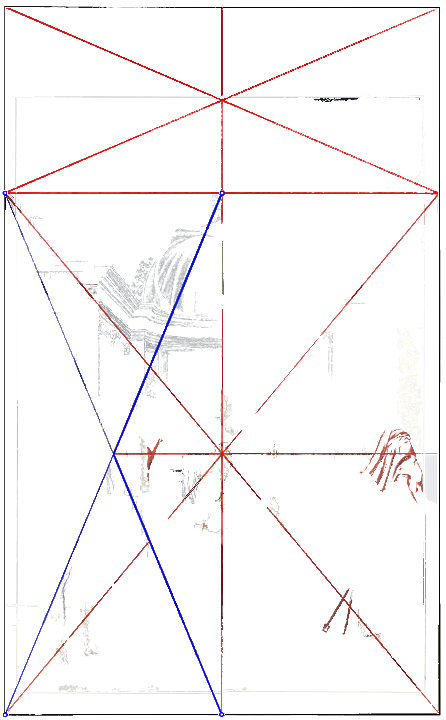
Sacred Geometry No. 1 transforms a geometric analysis of a Renaissance painting into an artwork. By separating the analytical framework from the painting it once explained, the work invites reflection on visual order, abstraction and the historical systems through which images organise perception.
The geometric framework used in this work is derived from Piero della Francesca's The Brera Madonna (Montefeltro Altarpiece) (c. 1472–1474). The analysis follows one of many attempts to identify the compositional structures believed to organise the painting's spatial and visual harmony.
Piero della Francesca, The Brera Madonna (Montefeltro Altarpiece),
c. 1472–1474, shown with geometric analysis.
For centuries, artists, historians and, more recently, software have searched Renaissance paintings for geometric structures thought to underpin their harmony, balance and composition. These analytical frameworks promise access to an underlying visual order, reducing the complexity of an image to a system that can be measured, described and understood. Rather than questioning these interpretations, Sacred Geometry No. 1 asks what happens when the framework itself becomes the object of attention.
The work treats the extracted geometry as a found object: not discovered, but recognised as something that can exist independently of the image it was created to explain. Detached from the painting, it no longer functions as an explanation. It becomes available for another kind of attention.
Freed from its original purpose, the extracted framework begins to shift in meaning. It resembles an abstract composition, an archaeological artefact, a technical diagram or a computational image. It occupies a space between these histories without belonging entirely to any of them, inviting reflection on how visual systems acquire authority and how they continue to shape the ways in which the world is represented.
The work also places this history alongside contemporary machine vision. While Renaissance geometry sought universal principles capable of explaining the organisation of an image, today's AI systems often predict through statistical relationships rather than explicit rules. Different methods, perhaps, but driven by a similar impulse: the search for patterns that reduce uncertainty and make the world intelligible.
Rather than presenting geometry as a timeless truth, Sacred Geometry No. 1 considers it as one visual regime among many. Perspective, abstraction, photography and machine vision each represent different historical ways of organising perception. The extracted framework becomes less a relic of Renaissance painting than an artefact of a persistent human desire to make the world intelligible through systems that eventually become invisible to those who inherit them.
Sacred Geometry No. 1 transforms a geometric analysis of a Renaissance painting into an artwork. By separating the analytical framework from the painting it once explained, the work invites reflection on visual order, abstraction and the historical systems through which images organise perception.
The geometric framework used in this work is derived from Piero della Francesca's The Brera Madonna (Montefeltro Altarpiece) (c. 1472–1474). The analysis follows one of many attempts to identify the compositional structures believed to organise the painting's spatial and visual harmony.
Piero della Francesca, The Brera Madonna (Montefeltro Altarpiece), c. 1472–1474, shown with geometric analysis.
For centuries, artists, historians and, more recently, software have searched Renaissance paintings for geometric structures thought to underpin their harmony, balance and composition. These analytical frameworks promise access to an underlying visual order, reducing the complexity of an image to a system that can be measured, described and understood. Rather than questioning these interpretations, Sacred Geometry No. 1 asks what happens when the framework itself becomes the object of attention.
The work treats the extracted geometry as a found object: not discovered, but recognised as something that can exist independently of the image it was created to explain. Detached from the painting, it no longer functions as an explanation. It becomes available for another kind of attention.
Freed from its original purpose, the extracted framework begins to shift in meaning. It resembles an abstract composition, an archaeological artefact, a technical diagram or a computational image. It occupies a space between these histories without belonging entirely to any of them, inviting reflection on how visual systems acquire authority and how they continue to shape the ways in which the world is represented.
The work also places this history alongside contemporary machine vision. While Renaissance geometry sought universal principles capable of explaining the organisation of an image, today's AI systems often predict through statistical relationships rather than explicit rules. Different methods, perhaps, but driven by a similar impulse: the search for patterns that reduce uncertainty and make the world intelligible.
Rather than presenting geometry as a timeless truth, Sacred Geometry No. 1 considers it as one visual regime among many. Perspective, abstraction, photography and machine vision each represent different historical ways of organising perception. The extracted framework becomes less a relic of Renaissance painting than an artefact of a persistent human desire to make the world intelligible through systems that eventually become invisible to those who inherit them.